Quick Train Canada offers programs in a variety of sectors giving you a competitive advantage in Canada’s changing economy.
Scroll to browse all training offered through Quick Train Canada or use the search features to better tailor your results.
Conservation of Canada’s resources is essential in the green economy. A modern conservationist is multidisciplined and provides a balanced program which includes using sustainable wildlife management techniques that will lead to a future where aquatic and wildlife ecology remain healthy and abundant. Mapping and compassing are integral skills for the Ecological Conservationist. In this microcredential, you will learn to interpret maps and develop skills in ground and map measurements. You will also learn the basics of internet mapping software. This microcredential is the first of a suite of six training opportunities to prepare participants to work as an Ecological Conservationist.
The intended audience is anyone wanting to enter the natural resource/environmental tourism sector or supplement their current training. Technicians who work in northern mines, or for environmental consulting companies, and do field sample collection, would benefit from understanding wildlife management techniques. The intended learners are Indigenous youth and adults. The earner of this microcredential will be able to describe the ecological land classification system ecology of land associated with lake ecosystems and understand resource legislation relevant to Indigenous peoples and how these topics relate to conservation management.
In this 30-hour online course, Mass Timber Products and Systems, you’ll explore the fundamentals of mass timber manufacturing, building systems, and their real-world applications. This instructor-guided course is ideal if you work in forestry, manufacturing, construction, skilled trades, project management, or engineering and design, and want to expand your understanding of mass timber to help you identify, select and integrate various mass timber products and systems into current or future projects. Complete this prerequisite course, the second Sustainable Mass Timber Construction course, and the third Technology in Mass Timber Design and Construction course to earn SAIT’s Sustainable Mass Timber Construction and Design Certificate of Completion. Receive a SAITMicro digital badge if you meet the earning criteria for this microcredential.
In this 60-hour online course, Measurement, Monitoring & Verification (MMV), you’ll explore key topics in the growing field of carbon sequestration. You will study thecharacteristics and properties of CO2 and how they affect long-term storage, and the regulations, approaches, and technologies used. The course also covers site planning, modeling, monitoring, and data analytics for effective verification. Designed for professionals experienced in subsurface and reservoir modeling, geoscience, well planning, data analytics, and regulatory reporting, this instructor-guided course offers practical knowledge and insights for immediate application.Complete the prerequisite Introduction to Carbon Capture and Storage (CCS) and this course to earn SAIT’s Carbon Capture and Storage (CCS) Certificate of Completion. Receive a SAITMicro digital badge if you meet the specified earning criteria for this micro-credential.
As self-sufficient energy systems, microgrids are pivotal to a resilient and sustainable energy future. Microgrids: The Technical Aspect provides an in-depth exploration of critical components, operating principles, and design considerations essential for successful microgrid implementation. By the end of the course, you will gain a profound understanding of the various technical aspects that make microgrids a cornerstone of modern energy solutions.
Learners should have a good understanding of electric generation, transmission, power systems analysis, microgrid operation, and renewable energy.
The course introduces the fundamental concepts of electrical overhead distribution systems and design. Based on the student’s previous working experience and education, and knowledge from the first course in the microcredential (Fundamentals of Distribution Design), it provides an overview of electrical overhead distribution systems and develops concepts of overhead distribution design. Topics include components, design considerations, standards, conductors, pole types, pole calculations, transformers, grounding, loads (residential, commercial, industrial), applications, and safety and economical considerations. Software tools will be used for modeling and simulation throughout this course.
Residential Building Science Fundamentals introduces professionals to essential building science principles and the “House as a System” approach, showing how water, air, heat, and vapour interact to affect home performance. This microcredential course explores material selection for climate-resilient construction, strategies for passive heating and cooling, indoor environmental quality, and methods for measuring and reducing operational and embodied carbon. Building a strong foundation in residential performance is the first step toward successful deep energy retrofits.
Learners will engage in 24 hours of learning over three weeks, combining instructor-led virtual sessions with online self-study. Interactive discussions, assignments, and practical exercises help you connect technical knowledge to real-world residential projects.
In this 24-hour online course, Residential Deep Energy Retrofit Fundamentals, you’ll build on foundational building science to explore deep retrofit strategies, homeowner motivations, and cost/benefit trade-offs. Learn to plan integrated upgrades including electrification, resilience measures, and envelope/mechanical coordination, while engaging collaborative design and stakeholder alignment. This course is ideal for renovation professionals, energy advisers, designers, and trades interested in advancing retrofit planning skills.
Funded in part by the Government of Canada’s Sectoral Workforce Solutions Program.
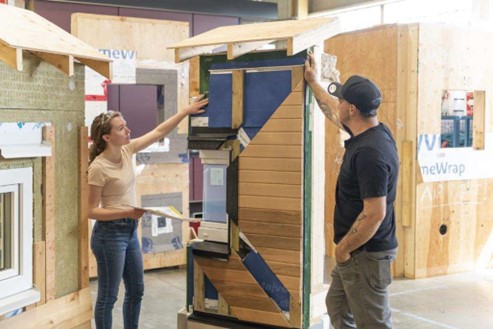
This two-day course equips window installers and related trades with the knowledge and skills to deliver high-performance installations. Through classroom instruction, live demonstrations and hands-on experience, participants learn how to select windows and apply proven installation methods for low-rise, wood frame construction. White the course primary focuses on new construction; it also addresses the challenges of window replacement in older homes.
Funded in part by the Government of Canada’s Sectoral Workforce Solutions Program.
Develop asset management solutions with practical knowledge of design principles to set up a database system. You will learn to use project methodology in various scenarios and how to present solutions. This microcredential is for those who have less than two years of academic training or work experience in GIS and is focused on using the technology to manage and maintain assets. If you do not have previous experience in GIS, it is strongly recommended that you complete the Introduction to GIS: Geospatial Data microcredential before enrolling in other GIS microcredentials.
This microcredential focuses on the operation of mechanically driven boats as it pertains to the operator’s safety and the procedures to limit the impact of the equipment on the environment. This includes limiting air pollution and controlling and minimizing hazardous spills in the waterways in which we operate.
The microcredential is specifically designed to train Indigenous producers in Northern Saskatchewan. The design and delivery support, acknowledge, and respect the learners’ needs and time. To meet the needs of students, the online course has been designed to be user friendly, highly engaging, and interactive. Producers and boat users from all areas of Canada will benefit from taking the course.
Ecology, Biology, and Saskatchewan Wildlife Management: Water and wildlife are two of Canada’s most precious resources. It is important to understand the ecology of each. In this microcredential, participants will examine how wildlife populations relate to their environment. Participants will also learn the life history and biology of Saskatchewan wildlife and examine at-risk species in Saskatchewan.
The target audience is anyone wanting to enter the natural resource/environmental tourism sector or supplement their current training. Technicians who work in northern mines, or for environmental consulting companies, and do field sample collection, would benefit from understanding wildlife management techniques. The intended learners are Indigenous youth and adults. The earner of this micro-credential will be able to describe the ecological land classification system ecology of land associated with lake ecosystems and understand resource legislation relevant to Indigenous peoples and how these topics relate to conservation management.
Various sensors can be found in today’s agricultural operations. This microcredential provides a summary of the range of IoT sensors, the technology required to utilize the sensors, and collection and storage of data. The ideal learner will be looking to adopt sustainable farming practices using data and already be employed in the farming industry, either as an employee or owner. It is expected that the learner will have at least basic digital skills. The learners will complete the modules at their own pace. Therefore, this microcredential has been developed fully online.
Prior Learning
Recommended, but not necessary, to complete IOT Agriculture Essentials before enrolling
The Supervising Net-Zero and Passive House Construction microcredential is for individuals in the construction industry, or those who have recently completed a related construction program, who are seeking to gain the skills, knowledge, and tools unique to supervising construction on Net-Zero, Net-Zero-Ready, or Passive House construction projects.
Whether they want to coordinate and supervise smaller teams and sub-trades on smaller projects (Part 9 buildings) or work with larger teams on complex projects (larger Part 9 or Part 3 wood-frame buildings), learners will develop their ability to manage compliance with the performance requirements of BC Energy Step Code and Net-Zero Energy and Passive House standards and prepare for the upcoming changes to the National Building Code.
The microcredential consists of five courses that build upon each other in knowledge and focus on practical examples in wood-frame buildings. Upon completion, learners will have:
Confidence to ensure project compliance with performance requirements and compliance process of the BC Energy Step Code and Passive House
In-depth knowledge to inform design, coordinate work, and control construction quality to achieve airtightness and enclosure (low-TEDI) performance levels
Experience with tools and strategies to support site supervision activities gained with coaching from seasoned industry
In this 30-hour course, participants will learn about sustainability, how it relates to the built environment, and how buildings contribute to climate change. Participants will also explore how buildings can be made more energy efficient and greener through recommissioning, retrofitting, and renewal. The course introduces basic energy calculations and terminology along with strategies for energy use reduction and awareness of regulations, policies, and sustainability standards for future retrofits. Key topics include carbon footprint analysis, building enclosure control layers, occupant health and wellness rating systems, waste management, and green retrofitting strategies such as heat recovery and low-carbon electrification.
Funded in part by the Government of Canada’s Sectoral Workforce Solutions Program.
This microcredential will provide the knowledge and know-how for driving business performance through a focus on sustainability.
Building on a foundational understanding of sustainability and how it impacts business performance, you will learn proven strategies to address growing demands for enhanced environmental and social governance, while simultaneously improving business performance.
This microcredential is for graduates and working professionals, who wish to build their knowledge in sustainable business management to accelerate their careers.
This course will prepare students to manage successful, sustainable events. Students will gain a practical and critical perspective on how to identify and meet participant, organizational and community needs, plan and improve logistics, solve problems and enable sound and ethical stewardship of economic, social and environmental resources.
This course focuses on what’s needed for an effective food distribution system. You will develop a comprehensive understanding of monitoring shipments with tracking and tracing practices, technology and transaction protocols.
You will examine the complexities of track and trace in relation to authenticity, safety and sustainability. You will also address issues related to environmental impact, social equity and economic viability. The course’s industry-focused curriculum will explore what’s needed to ensure a safe food supply.
The course offers hands-on learning through case studies, guest lectures and online collaboration.
This microcredential is for graduates and working professionals who are interested in enhancing their knowledge of sustainable supply chain practices or helping their organizations achieve environmental, social and governance related goals.
In this 30-hour online course, Sustainable Mass Timber Construction, you’ll explore sustainable forestry practices, mass timber production, and the supply chain. Learn to assess environmental impacts through life cycle analysis and manage every phase of a mass timber project—from design to close-out—with a focus on project management and safety. Instructor-supported, this course is for professionals in construction, project management, sustainability, or building compliance who want to adopt sustainable mass timber practices. Complete prerequisite course, Mass Timber Products and Systems, this course, and the third course, Technology in Mass Timber Design and Construction, to earn SAIT’s Sustainable Mass Timber Construction and Design Certificate of Completion. Receive a SAITMicro digital badge if you meet the earning criteria for this microcredential.